
What makes an argument sound? This note separates two things that are often confused: the truth of the premises and the validity of the reasoning. Using simple examples rewritten with variables, it shows that validity depends only on an argument’s form, and that a single counterexample is enough to prove a form invalid, even when every statement in the original example is true.
✅ Sound argument
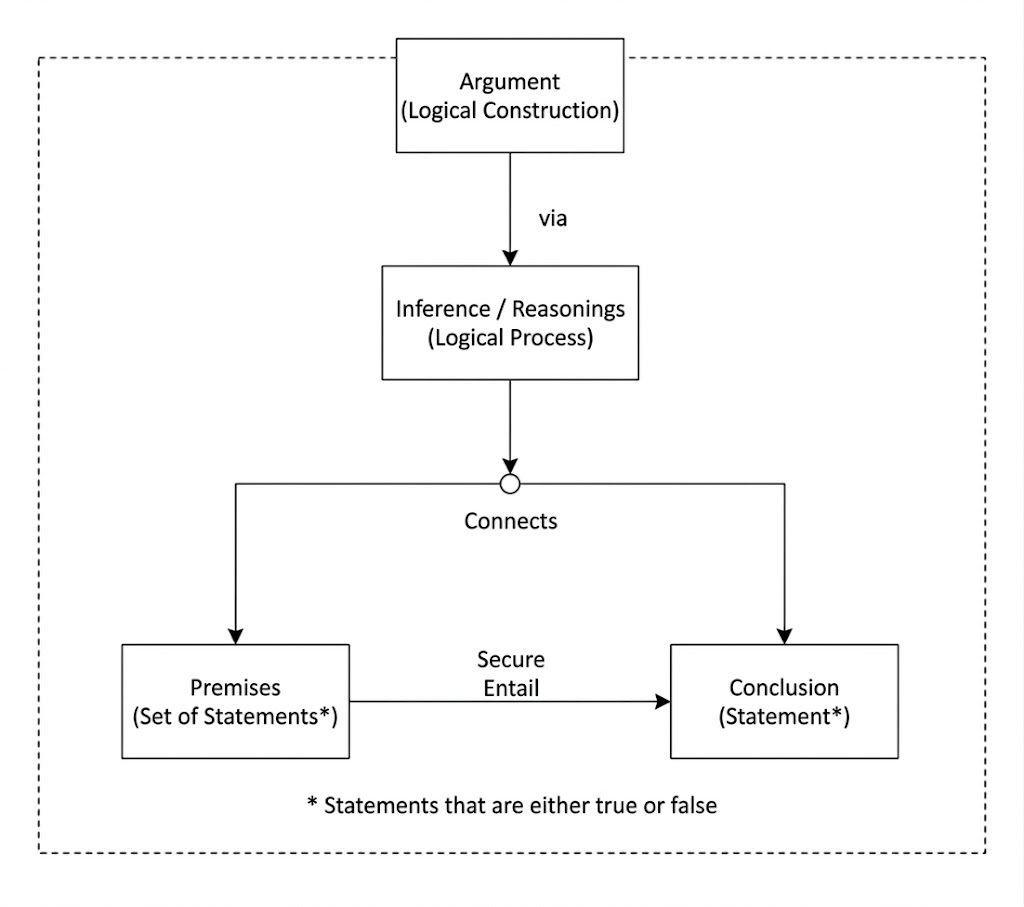
A sound argument is one that rests on true premises and valid reasoning.
Premises:
- All cats are mammals.
- Whiskers is a cat.
Conclusion:
- Whiskers is a mammal.
🔢 Rewriting the argument with variables
Premises:
- All ① are ②.
- ③ is a ①.
Conclusion:
- ③ is a ②.
Every argument of this form is sound, regardless of what the variables stand for, as long as the premises are true. Reasoning of this form is valid, so it guarantees that the conclusion will be true.
⚠️ When an argument is not sound
- When one or more of the premises are false.
- When the reasoning is not valid.
❌ Example of an unsound argument (due to invalid reasoning)
Premises:
- All mammals have lungs.
- All dogs have lungs.
Conclusion:
- Therefore all dogs are mammals.
🔢 Rewriting the argument with variables
Premises:
- All ① have ②.
- All ③ have ②.
Conclusion:
- All ③ are ①.
Every argument of this form is unsound, regardless of the variables, because the reasoning is invalid. Even though every statement in this example is true, the argument is not sound.
🧩 Showing the form is wrong (via a counterexample)
We substitute the variables:
| Variable | Substitution |
|---|---|
| ① | mammals |
| ② | lungs |
| ③ | lizards |
This gives:
- All mammals have lungs.
- All lizards have lungs.
Conclusion:
- Therefore all lizards are mammals.
The conclusion is false, while the premises are true. So the reasoning is invalid. A line of reasoning that leads from true statements to a false conclusion is invalid.
Sound = True premises + Valid reasoning Unsound = A false premise or Invalid reasoning
Leave a comment
Comments are moderated, and appear with the site's next update.