Emmy Noether
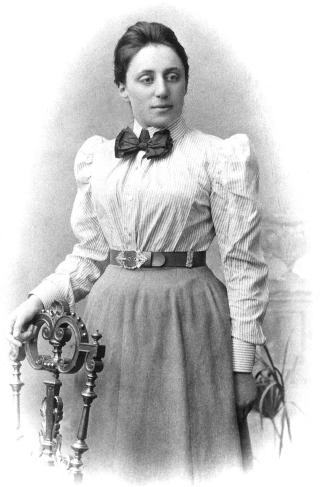

German Jewish mathematician (1882-1935).
Pronunciation
In German, the “oe” in Noether represents ö, while the “th” is pronounced simply as t. Spelling alone is not always enough to decide, since in other names “oe” is a genuine long o, but here the family history confirms it: according to her MacTutor biography at the University of St Andrews, when the Tolerance Edict of Baden (1809) required Jews to adopt German names, her great-grandfather Elias Samuel chose the surname Nöther, while her father, Max, and his family always used the form Noether. In English, one encounters two versions: some pronounce the “th” as voiceless, as in “thin”, while others pronounce it as voiced, as in “this”.
You can hear the name pronounced in German on Forvo.
Sex as an obstacle to her academic career
Hilbert and Klein invited her to Göttingen in 1915, but the university refused to grant her the habilitation that would have let her teach in her own name: the objection was to her sex (today we would say gender; “sex” is the word the period itself used). For four years her courses were therefore announced under Hilbert’s name, with a line noting that they would be given by Miss Noether. She was not paid. She wrote the 1918 paper containing the theorem under these conditions; her habilitation came only in 1919.
Hilbert is said to have answered the faculty that he did not see why the candidate’s sex should be an argument against her admission, since this was a university and not a bathhouse. The exact wording is reported differently in different sources, so it is best treated as a remembered remark rather than a quotation.