Glossary:Equivalised disposable income
Eurostat’s definition of equivalised disposable income and of the modified OECD scale (1 / 0.5 / 0.3). It is kept as a source of the article «Τι εισοδήματα έχουν τα ελληνικά νοικοκυριά;» (What incomes do Greek households have?), which measures incomes on this scale. The address requested, the entry «Equivalised household size», redirects to this page.
The text of the page
A copy of the text as the page rendered it at the moment of capture. It is not my text: it belongs to its authors and its publication, and it is reproduced here so that whatever relies on it stays checkable if the link stops working. The formatted page is preserved in the screenshot and the DOM, below.
The equivalised disposable income is the total income of a household, after tax and other deductions, that is available for spending or saving, divided by the number of household members converted into equalised adults; household members are equalised or made equivalent by weighting each according to their age, using the so-called modified OECD equivalence scale.
The equivalised disposable income is calculated in three steps:
all monetary incomes received from any source by each member of a household are added up; these include income from work, investment and social benefits, plus any other household income; taxes and social contributions that have been paid, are deducted from this sum; in order to reflect differences in a household’s size and composition, the total (net) household income is divided by the number of ’equivalent adults’, using a standard (equivalence) scale: the modified OECD scale; this scale gives a weight to all members of the household (and then adds these up to arrive at the equivalised household size): 1.0 to the first adult; 0.5 to the second and each subsequent person aged 14 and over; 0.3 to each child aged under 14. finally, the resulting figure is called the equivalised disposable income and is attributed equally to each member of the household. For poverty indicators, the equivalised disposable income is calculated from the total disposable income of each household divided by the equivalised household size. The income reference period is a fixed 12-month period (such as the previous calendar or tax year) for all countries except UK for which the income reference period is the current year and Ireland (IE) for which the survey is continuous and income is collected for the last twelve months.
| Available documents | size | download | |
|---|---|---|---|
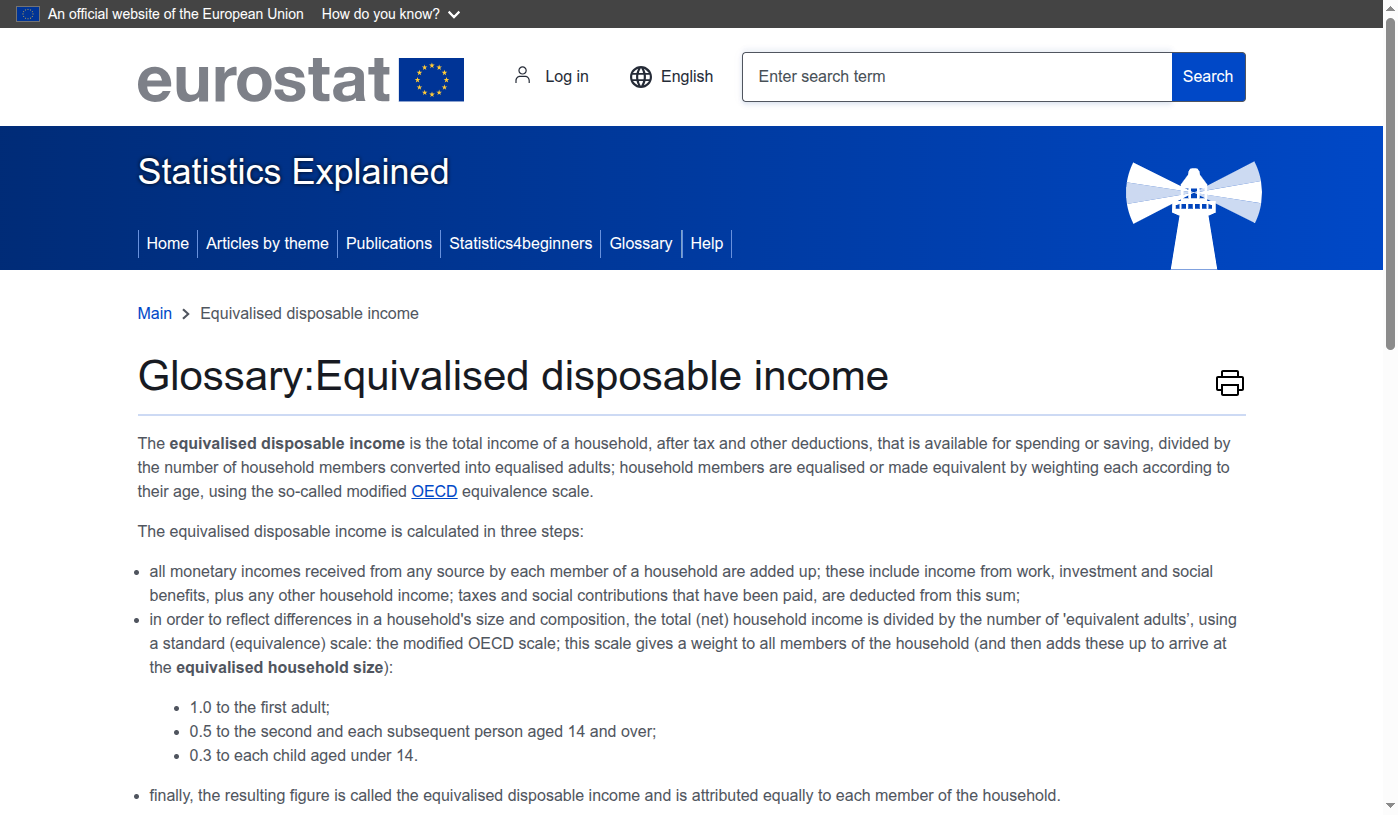 | 2026-09-12T18-29-50-utc_ec.europa.eu.visible.png (png)screenshot visible | 225K | ⭳ |
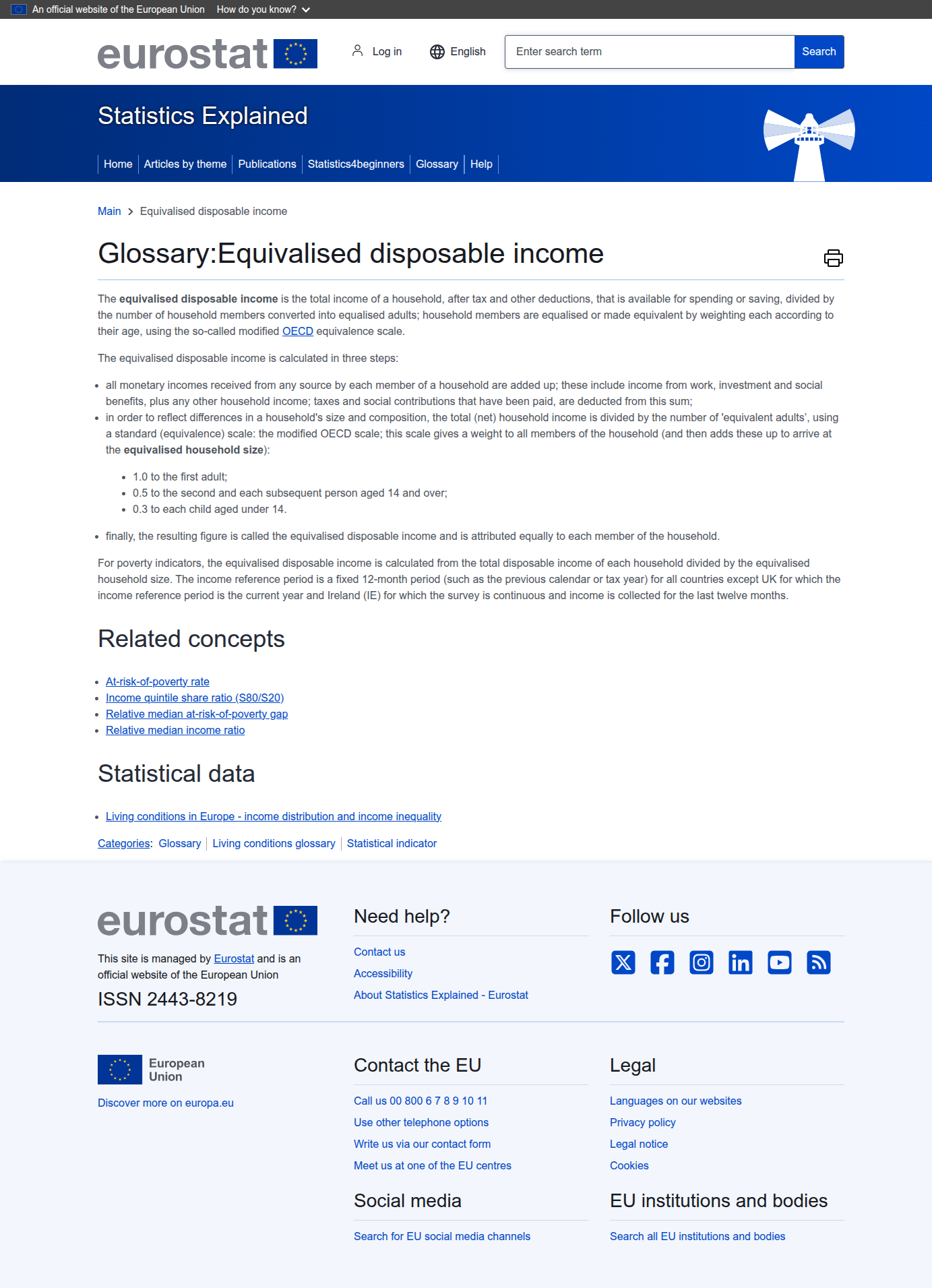 | 2026-09-12T18-29-50-utc_ec.europa.eu.fullpage.png (png)screenshot full-page | 386K | ⭳ |