
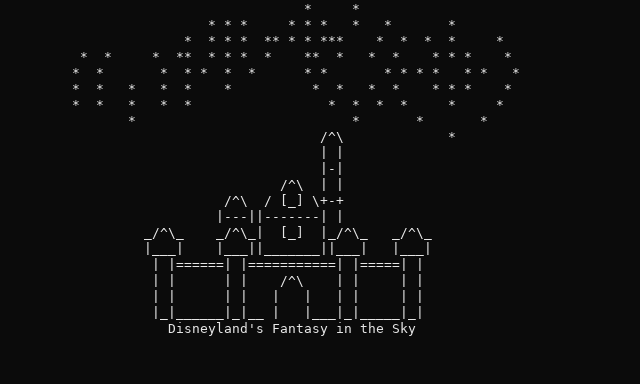
In the 1990s I worked on UNIX terminals, at college and at home, and followed alt.ascii-art.animation on Usenet. Soon I was making animations of my own too. In 1998 I gathered and sorted the VT100 ones I had collected, so that they would not be lost, and in 2026 I went back to the backups of those years to make this collection.
At home I had first Coherent and then Linux, to which at some point I connected second-hand terminals that I had bought. I also saw ASCII art on the BBSes I dialled into. I made my own animations frame by frame, in DOS EDIT and on Linux, together with tools for viewing them.
Today the collection went public in two places. On GitHub, as a repository: ascii-art-animations-1980-2000. And here, on maistrelis.com, where every file has a page of its own and plays in the browser.
There are 394 files from 1980 to 2000, most of them from the 1990s. The core is the 101 files of my own 1998 package, and around it are files from 18 other sources: Usenet posts, DECUS tapes, BSD Unix, old FTP sites and late-1990s web pages that survive today in the Wayback Machine. I could not find 36 of them anywhere else online. Usenet posts carried the animations as uuencoded attachments, and the Google Groups archive now shows them as <uuencoded_portion_removed>.
These animations have no clock of their own. Their pace was the speed of the serial port, usually 2400 to 9600 baud, and on a modern computer they are over in an instant. The player here shows each byte at the moment the serial line would have delivered it, and the repository’s play.sh does the same in a terminal.
The “tools for viewing them” above are ASCIIANI and asciianm. On 26 December 1996 I drew a train in DOS EDIT, frame by frame, one frame on each page of the editor, and watched it move by holding down Page Down. The next day I wrote a small program in Turbo Pascal that turned the pages by itself: ASCIIANI. The idea was different from that of the .vt files: the animation is plain text, split into frames of a fixed height, and the timing is not written into the bytes. The first version, though, waited by counting an empty loop, so it too ran as fast as the computer allowed. From October 1997 it counted milliseconds, and each animation carried its own settings on one line, modelled on KANGAROO’s “Ascii Art Animator”. The tools of the scene borrowed ideas from one another.
On 12 February 1998 I posted version 3.1 to alt.ascii-art.animation. The replies came within five days, in alt.ascii-art: a Linux user could not run it, because it was for DOS, and Martin Atkins wrote “Works for me, and it is actually quite good!”. The signature of that post was itself a small C program that printed my e-mail address one character at a time, and it is in the collection as a .vt, bells and all. In November of the same year I rewrote the program in C for Linux, with ncurses, as asciianm. It was my first program in C, and I learned C by writing it. Version 2 came out in 2002. asciianm now lives in the repository’s asciianm/ folder, under the GNU GPL, and play.sh uses it to play in a terminal the animations that also exist as text frames.
For every file I recorded where it came from, who made it, and how certain the attribution is. The About page explains it in detail, and the People tab gathers the roughly 100 people who made, posted or collected them.
If you made one of these, if you know who made one marked unknown, or if you saved alt.ascii-art.animation in the 1990s, write to me or open an issue on GitHub.
The signature of that post, as it survives, with the e-mail addresses masked:
/<\                         .---------------------------.      . .
\_\/\                       | Save www.fidonet.gr       |    _\./_
 \_\/\                      | Save the Dream of BBSing  |    ,/~\.
  \_\/    .-----------------|      www.linux.org        |_   |
    (~)    Maistrelis kostas|   promote free software   |   (~)
  *'-~-`*  fm██@tee.gr      | against commercialization | *'-~-`*
 *    == * fm██@freemail.gr `---------------------------'*    == *
 *    += * icq mail:                                     *    += *
__*_____*_ 395████@pager.mirabilis.com     ..   . . .    _*_____*___gcc_prog._
p(r,c) int r;char c;{int i,j,k;for(i=1;i<r;i++){for(j=1;j<i;j++) {printf(" ")
;}printf("%c",c);for(k=1;k<999;k++){printf("\a");}printf("\r");}} main(){char
e[]={"fm██@freemail.gr"};int l;for(l=48;l>32;l--){p(l,e[l-33]);}printf("\n");}
Leave a comment
Comments are moderated, and appear with the site's next update.
Did you write about this on your own site?