Tree structures in PostgreSQL

About me

Kostas Maistrelis (Κώστας Μαϊστρέλης)

Developer @ altsol · reasonablegraph.org


~30 years with PostgreSQL

Started with Informix — never looked back


Greece PostgreSQL Users Group Meetup #2

Graph

  • Abstract representation of relationships between elements.
  • The elements = nodes (or vertices).
  • The relationships = edges.

More formally, a graph is a pair of sets:

G = (V, E)

where:

V = set of vertices
E = set of edges

That is: objects and the relationships between them.

Two basic types of graphs

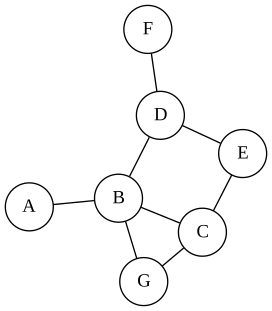
Undirected

  • The edges have no direction.
  • The edge {u, v} means: u is connected to v.
  • It holds both ways.

Directed

  • The edges have direction.
  • The edge (u, v) = connection from u to v.
  • Direction matters.

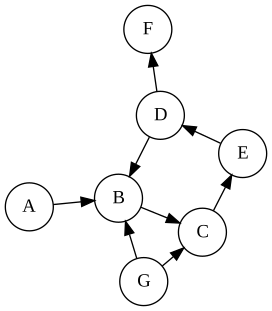
DAG — Directed Acyclic Graph
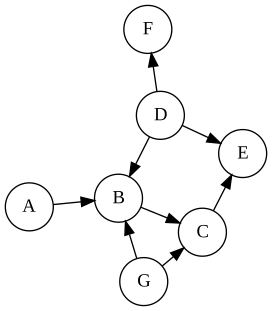
Directed graph WITHOUT cycles.

  • There is no path that, following the direction of the edges, returns to the starting node.
  • A node can have multiple parents.

Example:

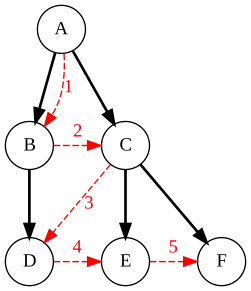
E has two parents (C and D).

Every tree is a DAG,
but not every DAG is a tree.

Tree
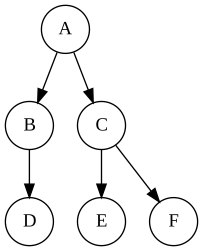
Connected graph without cycles.

  • If it has N vertices → exactly N - 1 edges.
  • Between any two nodes there is one and only one path.

In databases → rooted tree:

  • We pick one node as the root.
  • Every other node has exactly one parent.
  • The nodes below a node = its subtree.

Forest
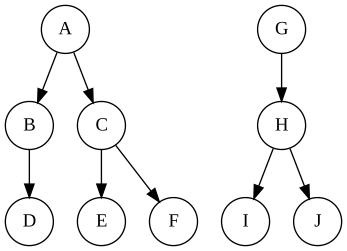
A collection of trees.

  • Each connected component is a separate tree.
  • A single tree = special case of a forest with one root.

In databases this means:

  • multiple roots,
  • each root has its own subtree,
  • each node has at most one parent.

Tree Traversals

Traversal = the process by which we visit all nodes of a tree in a specific order.

Two basic strategies

Strategy Idea
Depth-first (DFS) We go as deep as possible down one branch before backtracking.
Breadth-first (BFS) We visit all nodes of the same level first.

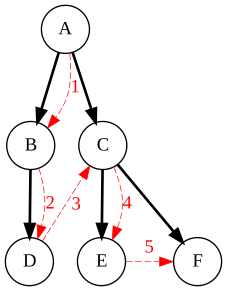
BFS — Breadth-first traversal

Level-by-level, from top to bottom.

Visit order:

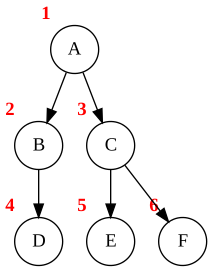
A,  B, C,  D, E, F
└─┘  └──┘  └─────┘
 0    1       2     ← levels

First the whole level 0, then the whole level 1, then the whole level 2…

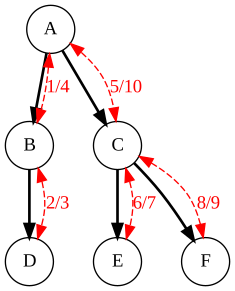
DFS — Depth-first traversal

As deep as possible down a branch before backtracking.

Visit order (pre-order):

A → B → D → C → E → F

Go to A, then to the first child (B), then to its child (D), end of branch → backtrack, then to the next branch (C → E → F).

Bridging to PostgreSQL

Up to here we have been talking mathematics.

In PostgreSQL the question becomes:

How do we store these relationships so that we can read quickly subtrees, ancestors and paths?

That is where the models come in:

  • Adjacency list + recursive CTEs
  • ltree (materialized path)
  • Closure table
  • (Nested Sets — only historically)

Adjacency List

Adjacency list — the model

A table with 2 columns for the hierarchy:

  • id — primary key
  • parent_id — pointer to the parent (self-FK)
CREATE TABLE node (
  id         BIGINT  PRIMARY KEY,
  parent_id  BIGINT  REFERENCES node(id),
  name       TEXT    NOT NULL
);

Our tree

 id | parent_id | name
----+-----------+------
  1 |      NULL | A
  2 |         1 | B
  3 |         1 | C
  4 |         2 | D
  5 |         3 | E
  6 |         3 | F
(6 rows)

Reads: Traversal By Level (before recursion)

Goal:
We want to traverse the tree level by level.

We would have to write one SELECT per level

SELECT ... WHERE id = 1                            -- root
UNION ALL
SELECT ... WHERE parent_id = 1                     -- level 1
UNION ALL
SELECT ... WHERE parent_id IN (SELECT id ...)      -- level 2
UNION ALL
...

The problem:

  • Needs one SELECT per level.
  • We have to know the maximum depth in advance.
  • 3 levels → 3 SELECTs. 10 levels → 10 SELECTs.
  • If tomorrow a new level is added → the query changes.

The solution: WITH RECURSIVE

Instead of:
▶     root, children, children of children, …

we write:
▶     start from the root, and as long as you find children, keep going

WITH RECURSIVE tree AS (
  -- Anchor: where we start
  SELECT id, parent_id, name, 0 AS depth
  FROM node
  WHERE id = 1

  UNION ALL

  -- Recursive: the next level
  SELECT n.id, n.parent_id, n.name, tree.depth + 1
  FROM node n
  JOIN tree ON n.parent_id = tree.id
)
SELECT * FROM tree ORDER BY depth;

This query implements the chain of SELECTs from the previous slide:
— the anchor (lines 2-5) = the first SELECT (WHERE id=1)
— the recursive term (lines 9-12) = each subsequent SELECT
The difference: instead of writing n SELECTs, PG runs the recursive term until it produces no new rows.

Result

 id | parent_id | name | depth
----+-----------+------+-------
  1 |      NULL | A    |     0
  2 |         1 | B    |     1
  3 |         1 | C    |     1
  4 |         2 | D    |     2
  5 |         3 | E    |     2
  6 |         3 | F    |     2
(6 rows)

What does “recursive” mean?

A recursive function as a mental model

Explanatory — not production code.

A recursive function has:

  • BASE (base case) → handle the current node
  • RECURSIVE STEP → call yourself for the children

These two pieces are exactly the two arms of a recursive CTE (anchor + recursive term).

Recursive function

CREATE FUNCTION traverse_tree(node_id BIGINT, depth INT DEFAULT 1)
RETURNS TABLE (id BIGINT, name TEXT, level INT)
LANGUAGE plpgsql AS $$
DECLARE child RECORD;
BEGIN
  -- BASE: return the CURRENT node
  RETURN QUERY
    SELECT n.id, n.name, depth FROM node n WHERE n.id = node_id;

  -- RECURSIVE: for each child, call YOURSELF
  FOR child IN
    SELECT n.id FROM node n  WHERE n.parent_id = node_id ORDER BY n.name
  LOOP
    RETURN QUERY
      SELECT * FROM traverse_tree(child.id, depth + 1);
  END LOOP;
END;
$$;

SELECT * FROM traverse_tree(1);

RECURSION STEP: Calls itself on line 15: traverse_tree(child.id, depth + 1)

SEARCH clause (PG 14+) — what it does

Picking a traversal strategy

  • SEARCH DEPTH FIRST | BREADTH FIRST — DFS or BFS
  • BY <columns> — order among siblings
  • SET <name> — opaque sortable column for the ORDER BY

SEARCH clause (PG 14+)

PostgreSQL ≥14 generates the sort column automatically:

WITH RECURSIVE tree AS (
  SELECT id, parent_id, name, 0 AS depth
  FROM node
  WHERE parent_id IS NULL

  UNION ALL

  SELECT n.id, n.parent_id, n.name, tree.depth + 1
  FROM node n
  JOIN tree ON n.parent_id = tree.id
)
SEARCH DEPTH FIRST BY name SET ordercol
SELECT id, parent_id, name, depth FROM tree
ORDER BY ordercol;

→ standard WITH RECURSIVE query with two extra lines:
    12: traversal type defined via ordercol
    14: ordering via ORDER BY ordercol
→ Cleaner, more declarative code — instead of the manual path array you had to carry yourself before PG14.

Problem: infinite recursion

PostgreSQL has no default recursion depth limit.

If the data has a cycle (broken parent_id, or actually a DAG instead of a tree), the recursive CTE runs forever — until statement_timeout or Out Of Memory.

Solution: CYCLE

  • Defense in queries over “dirty” trees — instead of hanging the session, it terminates and shows you the problem.
  • Traversing DAGs/graphs where a cycle is a legitimate possibility.

CYCLE clause (PG 14+)

BEGIN;
SET LOCAL statement_timeout = '5s'; -- fallback timeout

-- B (id=2) becomes child of D (id=4) → cycle B ⇄ D
UPDATE node SET parent_id = 4 WHERE id = 2;

WITH RECURSIVE descendants AS (
  SELECT id, parent_id, name, 1 AS level FROM node WHERE id = 2
  UNION ALL
  SELECT n.id, n.parent_id, n.name, d.level + 1
  FROM node n JOIN descendants d ON n.parent_id = d.id
)
CYCLE id SET is_cycle USING cycle_path
SELECT level, id, name, is_cycle, cycle_path FROM descendants;

ROLLBACK;

→ standard WITH RECURSIVE query with one extra line:
    13: CYCLE clause
        - CYCLE id — which column identifies the node
        - SET is_cycletrue on the row that closes the cycle
        - USING cycle_path — array with the path (the column is populated for every row, not just cycle-closing ones)
→ Cycle-safe by construction — no manual visited[] array to carry.

CYCLE — result

 level | id | name | is_cycle |   cycle_path
-------+----+------+----------+-----------------
     1 |  2 | B    | f        | {(2)}
     2 |  4 | D    | f        | {(2),(4)}
     3 |  2 | B    | t        | {(2),(4),(2)}
(3 rows)
  • is_cycle — marks rows where the path closes a cycle
  • cycle_path — records the visited path for every row (not just cycle-closing ones).

Writes — the easy side

All of the above is about reads. Writes are trivial:

-- INSERT: new node → one row
INSERT INTO node (id, parent_id, name) VALUES (7, 3, 'G');

-- MOVE subtree: change parent_id → the entire subtree "follows"
UPDATE node SET parent_id = 2 WHERE id = 3;

-- DELETE: one row (with ON DELETE CASCADE or re-parent)
DELETE FROM node WHERE id = 6;

→ No extra structure to keep in sync. parent_id is the single source of truth for the hierarchy.

Summary — trade-offs

✅ Pros

  • Trivial writes
  • Simple schema (one column)
  • Natural representation + FK integrity

⚠️ Cons

  • Reads require a recursive CTE
  • No ready-made level/path
  • No default cycle safety

In the next models (closure / ltree / nested sets) the trade-off
is reversed: cheaper reads, more expensive writes.

Closure Table

Closure — the model

1st table — node (the nodes)

Column Description
id unique identifier of the node

node can have additional payload columns (name, JSON, timestamps, …) — the model only cares about id.

2nd table — node_closure (all ancestor–descendant pairs)

Column Description
ancestor_id ancestor node (or the node itself)
descendant_id descendant node (or the node itself)
depth distance in edges: 0 = self, 1 = child, 2 = grandchild…

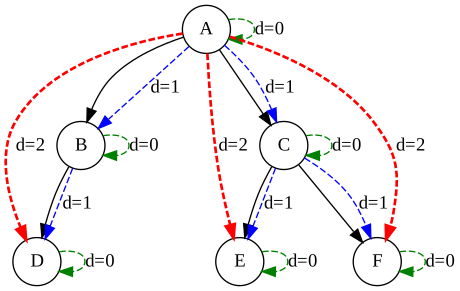
The table contains all (ancestor, descendant) pairs of the tree along with the self-pairs (depth = 0).
In this model the fact that a tree is at the same time a graph is highlighted.

Closure — Tables


CREATE TABLE node (
     id          BIGSERIAL PRIMARY KEY,
     name        TEXT NOT NULL
);

CREATE TABLE node_closure (
     ancestor_id    BIGINT NOT NULL REFERENCES node(id) ON DELETE CASCADE,
     descendant_id  BIGINT NOT NULL REFERENCES node(id) ON DELETE CASCADE,
     depth          INT    NOT NULL CHECK (depth >= 0),
     PRIMARY KEY (ancestor_id, descendant_id)
);

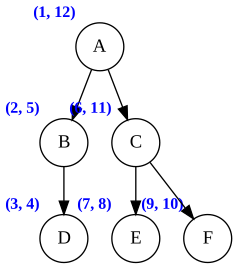
Our tree (A)

closure:
 id | name
----+------
  1 | A
  2 | B
  3 | C
  4 | D
  5 | E
  6 | F
(6 rows)
node_closure:
 ancestor_id | descendant_id | depth
-------------+---------------+-------
           1 |             1 |     0
           2 |             2 |     0
           1 |             2 |     1
           3 |             3 |     0
           1 |             3 |     1
           4 |             4 |     0
           2 |             4 |     1
           1 |             4 |     2
           5 |             5 |     0
           3 |             5 |     1
           1 |             5 |     2
           6 |             6 |     0
           3 |             6 |     1
           1 |             6 |     2
(14 rows)

Our tree (B)

The dashed arrows in the tree correspond to the rows of the node_closure table.

node_closure:
 ancestor_id | descendant_id | depth
-------------+---------------+-------
 A           | A             |     0
 B           | B             |     0
 A           | B             |     1
 C           | C             |     0
 A           | C             |     1
 D           | D             |     0
 B           | D             |     1
 A           | D             |     2
 E           | E             |     0
 C           | E             |     1
 A           | E             |     2
 F           | F             |     0
 C           | F             |     1
 A           | F             |     2
(14 rows)

Reads: BFS — by level

SELECT n.name, c.depth
FROM node_closure c
JOIN node n ON n.id = c.descendant_id
WHERE c.ancestor_id = 1   -- root (A)
ORDER BY c.depth, n.name;

No recursion — simple JOIN + ORDER BY.
The depth is ready in the table.

 name | depth
------+-------
 A    |     0
 B    |     1
 C    |     1
 D    |     2
 E    |     2
 F    |     2
(6 rows)

Reads: DFS pre-order

SELECT n.name, c.depth
FROM node_closure c
JOIN node n ON n.id = c.descendant_id
WHERE c.ancestor_id = 1   -- root (A)
ORDER BY (
  SELECT array_agg(a.ancestor_id ORDER BY a.depth DESC)
  FROM node_closure a
  WHERE a.descendant_id = c.descendant_id
);

For each node we build a path from the root as an array
(all the ancestors, by depth DESC)

 name | depth
------+-------
 A    |     0
 B    |     1
 D    |     2
 C    |     1
 E    |     2
 F    |     2
(6 rows)

DFS — the paths up close

SELECT n.name,
       array_agg(c.ancestor_id ORDER BY c.depth DESC) AS path
FROM node_closure c
JOIN node n ON n.id = c.descendant_id
GROUP BY n.name, c.descendant_id
ORDER BY path;

The same array that goes into the ORDER BY of the previous slide — here we see it as a column.

paths with id:

 name |  path
------+---------
 A    | {1}
 B    | {1,2}
 D    | {1,2,4}
 C    | {1,3}
 E    | {1,3,5}
 F    | {1,3,6}
(6 rows)
paths join with label:

 name |  path
------+---------
 A    | {A}
 B    | {A,B}
 D    | {A,B,D}
 C    | {A,C}
 E    | {A,C,E}
 F    | {A,C,F}
(6 rows)

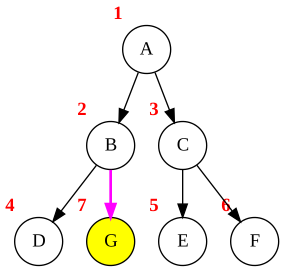
Write — adding node G under B

-- 1) The node itself
INSERT INTO node (id, name) VALUES (7, 'G');

-- 2) Self-row: every node is ancestor of itself (depth=0)
INSERT INTO node_closure VALUES (7, 7, 0);

-- 3) Inherit ALL the ancestors of the parent, with depth+1
INSERT INTO node_closure (ancestor_id, descendant_id, depth)
SELECT c.ancestor_id, 7, c.depth + 1
FROM node_closure c
WHERE c.descendant_id = 2;   -- the parent (B)

Write — result

→ →

New rows in node:

 id | name
----+------
  7 | G

New rows in node_closure:

 ancestor_id | descendant_id | depth
-------------+---------------+-------
           7 |             7 |     0   -- self        (G)
           2 |             7 |     1   -- parent      (B)
           1 |             7 |     2   -- grandparent (A)

1 row in node
3 rows in node_closure
( = depth(parent) + 1 )

Summary — trade-offs

✅ Pros

  • Reads without recursion (BFS, ancestors, descendants → flat joins)
  • The depth is ready in the table
  • “Is X an ancestor of Y?” → 1 row lookup
  • Friendly to the query planner (simple joins + indexed PK)
  • Works for DAGs too, not only trees

⚠️ Cons

  • Writes are multiple rows: 1 node → depth(parent)+1 closure rows
  • Move subtree expensive: re-compute all the pairs
  • Storage overhead that grows with depth
  • Two tables to keep in sync (triggers/functions)
  • DFS pre-order requires a correlated subquery (not as natural as BFS)

In the next model (ltree — materialized path) the hierarchy is stored as one column on the same table — a different reads/writes balance.

ltree

ltree — the model

One table — node (the whole hierarchy lives in the path column)

Column Description
id unique identifier of the node
path type LTREE — the path root → node as labels with .

node can have additional payload columns (name, JSON, timestamps, …)
— the model only cares about path (+ a stable label per node).

What LTREE is
  • Built-in type of PostgreSQL (extension ltree, in contrib).
  • Value: dot-separated labels — e.g. '1.2.4', 'shop.electronics.phones'.
  • Labels: alphanumeric + _ (no spaces, no special characters).
  • Operators: @> (is ancestor of), <@ (is descendant of), ~ (lquery match), @ (ltxtquery).
  • Comes with a GiST index → indexed ancestor/descendant lookups.

No extra structure — the hierarchy is one column on the same table.

ltree — Table

CREATE EXTENSION IF NOT EXISTS ltree;

CREATE TABLE node (
     id    BIGINT PRIMARY KEY,
     name  TEXT   NOT NULL,
     path  LTREE  NOT NULL UNIQUE
);

-- GiST: critical for ancestor/descendant queries (<@, @>, ~)
CREATE INDEX idx_node_path_gist ON node USING GIST (path);

Our tree

ltree.node:
 id | name | path
----+------+--------
  1 | A    | 1
  2 | B    | 1.2
  3 | C    | 1.3
  4 | D    | 1.2.4
  5 | E    | 1.3.5
  6 | F    | 1.3.6
(6 rows)
ltree.node:
 id | name | path
----+------+--------
  1 | A    | A
  2 | B    | A.B
  3 | C    | A.C
  4 | D    | A.B.D
  5 | E    | A.C.E
  6 | F    | A.C.F
(6 rows)

Reads: BFS — by level

SELECT name, nlevel(path) - 1 AS level
FROM node
WHERE path <@ '1'::ltree   -- root (A)
ORDER BY nlevel(path), name;
 name | level
------+-------
 A    |     0
 B    |     1
 C    |     1
 D    |     2
 E    |     2
 F    |     2
(6 rows)

No recursion<@ (“descendant of”) is served by the GiST index.
The level comes out of nlevel(path) — number of labels.

Reads: DFS pre-order

SELECT name, nlevel(path) - 1 AS level
FROM node
WHERE path <@ '1'::ltree   -- root (A)
ORDER BY path;
 name | level
------+-------
 A    |     0
 B    |     1
 D    |     2
 C    |     1
 E    |     2
 F    |     2
(6 rows)

Pre-order is free: the path of the parent is a prefix of the child
→ a single ORDER BY path is enough.

Write — adding node G under B

-- 1) Find the path of the parent (B = id 2)
SELECT path FROM node WHERE id = 2;   -- → '1.2'

-- 2) ONE row: path = parent_path || own_label
INSERT INTO node (id, name, path)
VALUES (7, 'G', '1.2' || '7'::ltree);
-- or equivalently:    text2ltree('1.2.7')

Write — result

New row in node:

 id | name | path
----+------+--------
  7 | G    | 1.2.7

1 row in node
( = independent of depth )

Summary — trade-offs

✅ Pros

  • One column for the whole hierarchy (not a second table)
  • Pre-order = ORDER BY path (free)
  • Ancestor / descendant with indexed @> / <@ (GiST)
  • nlevel(path) → level is ready
  • Cycle prevention on move: O(1) with one <@
  • INSERT = one row, independent of depth

⚠️ Cons

  • PostgreSQL-specific (extension ltree) — not portable
  • Move subtree expensive: rewrites path on all descendants
  • Path denormalized — duplication on every row
  • Labels with restrictions (alphanumeric + _)
  • Sibling order = text comparison on the labels (not numeric)

Compared to closure: the insert/move trade-off is reversed
(closure struggles on insert, ltree on move).
Compared to adjacency: cheaper reads (no recursive CTE),
but writes go beyond “one row” when the structure changes.

Nested Sets

Nested Sets — the idea

Each node gets 2 numbers from a DFS traversal:

  • enteringlft
  • leavingrgt

The subtree of a node = the nodes whose lft is inside the interval of the parent:

SELECT * FROM node child, node parent
WHERE parent.name = 'C'
  AND child.lft BETWEEN parent.lft AND parent.rgt;

C, E, F with one indexed range scan. Zero recursion, zero joins (apart from the self-join for the range).

Nested Sets — why NOT today

⚠️ Catastrophic writes

  • One insert/move → renumbering
  • On average half of the lft/rgt values in the table shift
  • Inserting a node = UPDATE of ~N/2 rows

Concurrency

  • Every write touches half the table
  • Practically single-writer

🧨 Fragility

  • The lft/rgt invariant breaks easily
  • The numbers have no meaning on their own

🚀 PG has better options

  • WITH RECURSIVE → adjacency reads
  • ltree → indexed subtree read without renumbering
  • Closure → indexed joins, supports DAGs

ltree does exactly the job of Nested Sets, without any of the drawbacks.

Score on the read/write spectrum:
Adjacency = cheap writes, expensive reads ·
Nested Sets = the opposite extreme: maximum reads, catastrophic writes ·
ltree & closure sit in the middle.

Comparison

Summary table

Criterion Adjacency ltree Closure
Subtree read recursive CTE (N iter.) 1 indexed predicate (<@) 1 indexed join
Leaf insert 1 row 1 row depth+1 rows
Subtree move 1 UPDATE (1 row) 1 UPDATE (N paths) N × depth edges
Cycle check on move recursive CTE O(1) with <@ O(1) PK lookup
Storage O(N) O(N) O(N × depth)
DAG / multiple parents
Integrity from the DB ✓ (1 FK) ✗ (denormalized string) ✓ (FK edges)
Extension ltree (contrib)
Query ergonomics medium high medium

Read benchmark — pre-order on 6,000 nodes

Model Time Buffers (shared hit) What the read path does
ltree ~13 ms 372 Seq scan + hash joins; plain ORDER BY path
closure ~35 ms 868 2× aggregation over 46,812 node_closure rows
adjacency ~39 ms 1545 Recursive Union — scans node per level
  • ltree ~3× faster, ~4× fewer buffers — it doesn’t compute, it reads columns.
  • adjacency pays the most buffers (recursion per level).
  • closure in between: one scan instead of recursion, but over a table 7.8× larger.

The buffers (8KB pages the query touched) are deterministic and
predict scaling — time is noisy.

Write benchmark — move subtree of 1,793 nodes

Model Rows written Buffers What the write path does
adjacency 1 ~26 one UPDATE of parent_id — the subtree follows
ltree 1,793 ~22,300 rewrites path of every node + GiST entries
closure 14,344 ~97,700 DELETE 5,379 + INSERT 8,965 edges + ~17,930 FK trg
  • adjacency almost free — the hierarchy is one parent_id.
  • ltree pays proportionally to the size of the subtree.
  • closure worst: writes subtree × depth edges + triggers.

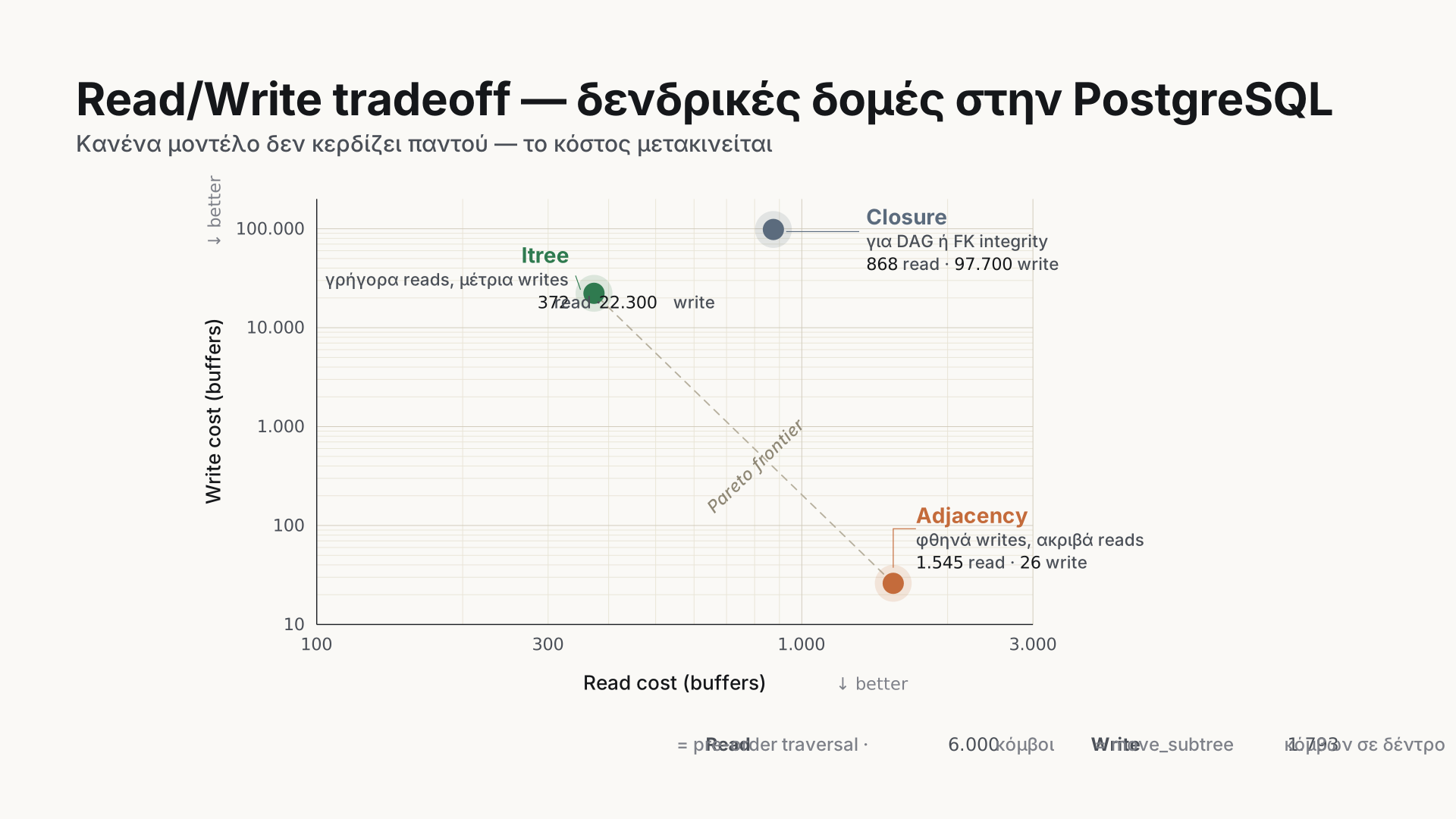
The read ↔︎ write symmetry

Model Read (pre-order) Write (move_subtree)
adjacency worst (1545 buffers) best (1 row)
ltree best (372 buffers) medium (1,793 rows)
closure medium (868 buffers) worst (14,344 rows)

No model wins everywhere — the cost simply moves around.

The central message of the whole presentation: you choose where to pay.

Read/Write trade-off — picture

Match the model to the workload

You have… Pick
Strict tree, simple keys, read-heavy ltree — the good default in PG
DAG / multiple parents closureltree cannot
Integrity from the DB (FKs on edges) closure
Edge data (weights, dates, “primary parent”) closurepath doesn’t fit it
Keys outside [A-Za-z0-9_] (UUID, Unicode) closureltree labels are restricted
No extension allowed closure or adjacency
Write-heavy, simple modeling adjacency — 1 row writes
None of the above — it just runs adjacency — the simplest, often enough

The comparison is not just ltree-vs-closure. For many applications, the adjacency list with a recursive CTE is simply “enough” — zero extension, one FK, cheapest writes.

About this talk

Join us

Greece PostgreSQL Users Group — open to anyone.